Recent reports about critical PHP security vulnerabilities have raised concerns among website owners, developers and businesses that depend on their websites to serve customers. The discussion has attracted additional attention because artificial intelligence (AI) played a role in helping researchers identify and investigate the security flaws.
If your website uses WordPress, Joomla, Drupal, Laravel or another PHP-based application, it is understandable to want to know what these reports mean for your website.
The good news is that security vulnerabilities can be addressed through timely updates, responsible server management and good website maintenance practices. At Magna Host, we take hosting security seriously, and our servers and PHP versions have been updated to address the reported vulnerabilities.
What are the recent PHP vulnerabilities?
PHP is a server-side programming language used to build and operate millions of websites and web applications. It handles tasks such as processing forms, communicating with databases, managing user sessions and generating dynamic web pages.
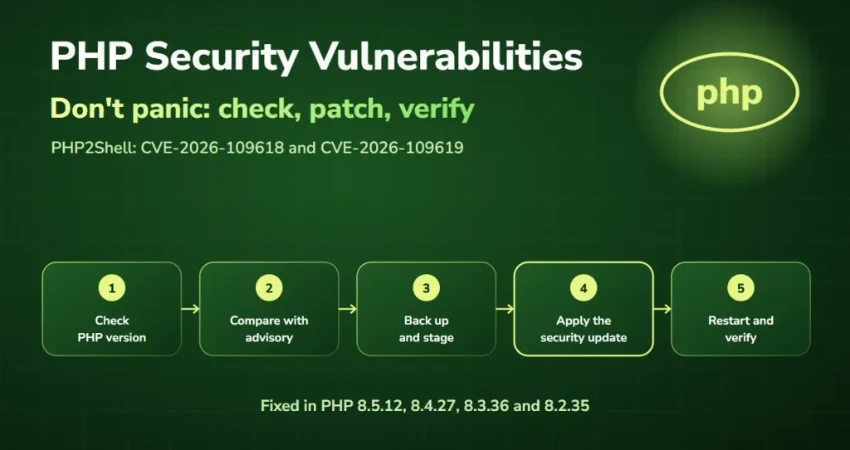
On 21 October 2026, two critical vulnerabilities in PHP's core engine were publicly addressed through security releases. They are identified as CVE-2026-109618 and CVE-2026-109619.
These flaws relate to how PHP manages memory under certain conditions. Depending on the affected environment, successful exploitation could allow an attacker to execute unauthorised code on a server or expose sensitive information.
Because the issues affect PHP itself, the risk is not limited to a particular WordPress plugin or website theme. Websites running affected PHP versions need their underlying PHP environment reviewed and updated.
Why is AI being mentioned in the reports?
Artificial intelligence is increasingly being used in cybersecurity research. AI-assisted tools can help researchers analyse complex software, investigate unusual behaviour and test potential security weaknesses.
In this case, researchers reported that AI helped make it practical to discover and investigate vulnerabilities that had remained difficult to identify. This demonstrates how AI can strengthen security research while also creating concerns about how similar capabilities might be misused.
However, the fact that AI helped researchers discover a vulnerability does not mean that every website is compromised or that every PHP installation can be attacked successfully. The actual risk depends on the software version, the server configuration and whether the relevant security updates have been applied.
Does this mean your website is unsafe?
Not necessarily. The important question is whether the PHP environment running your website has been updated to a version that addresses the vulnerabilities.
A website running an affected, unpatched PHP version may be exposed even if its design looks professional and its plugins are up to date. Conversely, applying the appropriate PHP security updates significantly reduces the risk associated with these specific flaws.
Website security is a shared responsibility. Hosting providers maintain the server environment, while website owners and developers must also maintain their applications, extensions, themes and account credentials.
How Magna Host is responding
At Magna Host, we recognise that our customers rely on their websites for business operations, communication and online visibility.
Our servers and PHP versions have been updated to address the reported vulnerabilities. We continue to prioritise server maintenance and security as part of our commitment to providing reliable hosting services.
Our objective is to help customers concentrate on running their websites and businesses without unnecessary concern about security headlines.
Nevertheless, no hosting provider can promise absolute immunity from every possible cyberattack. Keeping website applications updated and following good security practices remain important.
Five practical steps to help secure your website
1. Keep your website software updated. Install available security updates for WordPress, Joomla, Drupal, Laravel and other applications you use.
2. Update plugins and themes. Outdated third-party components can introduce separate security weaknesses even after PHP has been patched.
3. Use strong account passwords. Choose unique passwords for your hosting account, website administrator and email accounts. Enable multifactor authentication where available.
4. Maintain regular backups. Keep recent backups of your website files and databases so you can recover if a problem occurs.
5. Contact your hosting provider if you need help. If you are uncertain about your PHP version or the security status of your hosting environment, ask your provider to confirm the relevant updates.
Conclusion
The recent PHP vulnerabilities highlight why software maintenance and timely security updates are essential for every website owner. AI-assisted security research may change how quickly vulnerabilities are discovered, but established security practices remain important.
Magna Host has updated its servers and PHP versions to address the reported vulnerabilities. By combining a maintained hosting environment with regular website updates and sensible security practices, you can take practical steps to protect your online presence.
Looking for dependable, secure and affordable web hosting in Kenya? Visit Magna Host to explore our hosting services and find a suitable solution for your website.

Magna Host Team
Magna Host Offers Fast, Secure, affordable and Reliable Web Hosting, Email Hosting and Domain Name Registration Services in Kenya.