
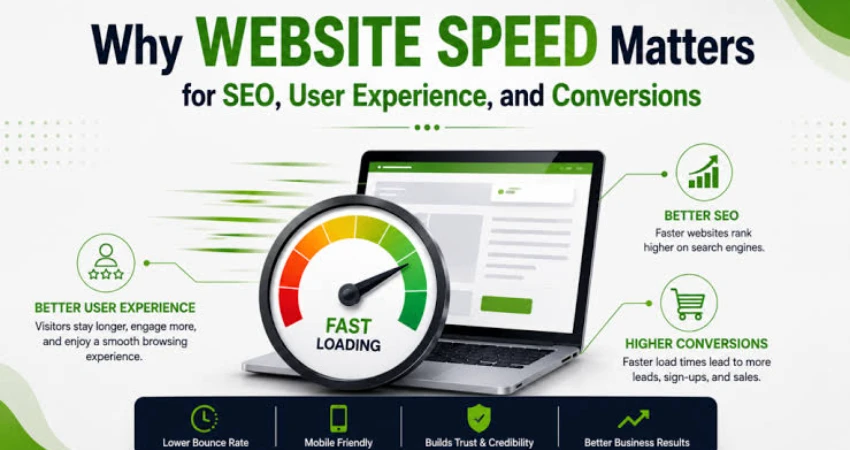
Website speed is one of the most important factors to consider when building and managing a business website.
Whether you run a small business, online shop, professional service, school, organization or personal brand in Kenya, visitors expect your website to load quickly and work smoothly on both computers and smartphones.
A slow website can create a poor user experience, reduce engagement and potentially cost your business customers.
This guide explains why website speed matters for Kenyan businesses, what causes websites to become slow, and what you can do to improve website performance.
What Is Website Speed?
Website speed refers to how quickly a webpage loads and becomes usable after someone visits it.
A fast website allows visitors to access important information quickly, while a slow website can leave visitors waiting.
Website performance can be affected by many factors, including:
- Web hosting
- Website code
- Images
- Plugins
- Databases
- Server configuration
- JavaScript
- CSS
- Third-party services
- Internet connection
- Mobile device performance
Improving website speed therefore requires looking at the entire website rather than focusing on just one factor.
Why Website Speed Matters for Kenyan Businesses
1. Visitors Expect Fast Websites
People have many choices online.
If someone searches for a product or service and your website takes too long to load, they may leave and visit another website.
A fast website helps visitors find information without unnecessary waiting.
2. Mobile Users Are Important
Many Kenyan customers access websites using smartphones.
This makes mobile performance particularly important.
Your website should not only look good on a phone but should also load efficiently on mobile devices.
A website with large images, unnecessary scripts and poorly optimized code can be frustrating to use on mobile.
3. Speed Can Affect User Experience
Imagine a customer trying to find your:
- Phone number
- Location
- Product price
- Service information
- Contact form
- Business hours
If every page takes a long time to load, the visitor's experience becomes frustrating.
Fast loading helps create a smoother browsing experience.
4. Speed Can Support Search Visibility
Search engines consider various aspects of website experience when evaluating websites.
Website performance is therefore an important part of technical SEO.
However, speed alone does not guarantee high rankings. A successful SEO strategy also requires useful content, relevant keywords, good website structure, mobile usability, links and other factors.
How Web Hosting Can Affect Website Speed
Your hosting environment is one part of your website's overall performance.
A website may have well-written content and optimized images but still experience performance problems if its hosting environment does not adequately support its requirements.
When choosing web hosting in Kenya, consider factors such as:
- Available resources
- Server performance
- Storage
- Control panel
- Website technology support
- Database performance
- Security
- Scalability
- Technical support
This is one reason why selecting an appropriate hosting package matters.
Common Causes of Slow Websites
Large Images
High-resolution images can consume significant amounts of data.
For example, uploading a camera photograph directly to your website without optimization can result in a much larger file than necessary.
Before uploading images, consider:
- Resizing them
- Compressing them
- Using appropriate formats
- Avoiding unnecessarily large dimensions
Too Many Plugins
WordPress websites can become slower when they use excessive plugins, particularly when plugins perform unnecessary tasks or conflict with each other.
Install only the plugins your website actually needs and keep them updated.
Poorly Optimized Themes
A visually impressive website can still have performance problems if its theme contains unnecessary code or resources.
Choose a well-built theme and remove features that are not needed.
Excessive JavaScript
JavaScript can provide useful functionality, but too much JavaScript can increase page loading and processing requirements.
Review scripts and third-party integrations that are not essential.
Large Databases
Websites that frequently store information in databases can accumulate unnecessary data over time.
Regular database maintenance can help keep a website efficient.
Poor Hosting Configuration
Hosting resources need to match the website.
A small personal website may have modest requirements, while an ecommerce platform with many products and visitors may require significantly more resources.
How to Improve Website Speed
1. Choose the Right Hosting Package
Do not select a hosting package based solely on price.
Consider your website's:
- Size
- Traffic
- Technology
- Number of email accounts
- Database requirements
- Storage needs
- Expected growth
A hosting package should provide enough resources for the website it is expected to support.
2. Optimize Your Images
Image optimization is one of the simplest ways to improve website performance.
Before uploading images:
- Resize oversized images
- Compress images
- Use modern image formats where appropriate
- Avoid uploading unnecessarily high-resolution images
Also avoid using a 3,000-pixel image when a much smaller image would work perfectly for the space where it appears.
3. Enable Caching
Caching allows frequently requested website resources to be stored temporarily so that they can be delivered more efficiently.
For WordPress websites, caching can be implemented using suitable caching solutions.
4. Reduce Unnecessary Plugins
Review your installed plugins regularly.
Ask:
Does this plugin provide a function my website actually needs?
If the answer is no, consider removing it.
5. Use a Lightweight Website Design
A simple, well-structured website can often provide a better experience than a website overloaded with animations and unnecessary visual effects.
Your website should prioritize:
Useful information + usability + performance.
6. Optimize Your Database
For database-driven websites, regular maintenance can help remove unnecessary information and improve database efficiency.
Always create a backup before performing significant database changes.
7. Reduce Unnecessary Third-Party Scripts
Third-party tools can add functionality to your website, but every additional external script can introduce another performance dependency.
Review:
- Chat widgets
- Tracking tools
- Advertising scripts
- Social media widgets
- External fonts
- Embedded content
Keep the services that provide genuine value and remove those that do not.
8. Make Your Website Mobile-Friendly
Website performance should be evaluated on mobile devices as well as desktop computers.
Check:
- Text readability
- Button sizes
- Navigation
- Images
- Forms
- Page loading
- Layout
- Menus
A mobile-friendly website should make it easy for visitors to accomplish what they came to do.
How to Test Your Website Speed
Website owners can use performance-testing tools to identify potential problems.
These tools can provide information about:
- Loading performance
- Image optimization
- JavaScript
- CSS
- Caching
- Mobile performance
- Technical recommendations
Do not become obsessed with achieving a perfect numerical score.
Instead, use performance tests to identify genuine problems and prioritize improvements that make your website faster and easier to use.
Website Speed and Ecommerce Businesses
Website performance becomes especially important for ecommerce websites.
An online customer may need to:
- Open your website.
- Browse products.
- View product details.
- Add products to a cart.
- Enter customer information.
- Proceed to checkout.
- Complete payment.
If several of these pages are slow, the customer experience can suffer.
For businesses selling products online, fast ecommerce hosting in Kenya should therefore be considered alongside website design, payment integration, security and customer support.
Website Speed and Professional Businesses
Service businesses also benefit from fast websites.
Consider a Kenyan customer searching online for:
- A lawyer
- Accountant
- Real estate company
- School
- Construction company
- Consultant
- Restaurant
- Digital agency
- Travel company
- Medical service provider
The visitor may simply want a phone number, location or price.
A fast website makes it easier for that person to find the information and contact the business.
Does Faster Hosting Automatically Make a Website Fast?
Not necessarily.
Hosting is important, but website performance depends on multiple factors.
A powerful hosting environment cannot completely compensate for:
- Huge images
- Poorly written code
- Too many plugins
- Excessive scripts
- Poor website architecture
- Unoptimized databases
The best approach is to optimize both the hosting environment and the website itself.
Choosing Fast Web Hosting in Kenya
When comparing hosting providers, look beyond the advertised storage space.
Consider the overall hosting environment and the tools provided to manage your website.
You should also consider whether the provider offers hosting suitable for the technology your website uses.
For businesses looking for web hosting in Kenya, Magna Host provides web hosting, WordPress hosting, email hosting and domain registration services.
Its hosting packages include:
- Starter Hosting – KSh 2,999/year
- Standard Hosting – KSh 5,999/year
- Executive Hosting – KSh 8,999/year
Magna Host uses DirectAdmin for hosting management, giving website owners access to tools for managing their hosting environment.
Website Speed Should Be Part of Your Business Strategy
Your website is often one of the first places potential customers interact with your business.
It should therefore be treated as a business asset rather than simply an online brochure.
A good website should be:
- Fast
- Secure
- Mobile-friendly
- Easy to navigate
- Easy to update
- Useful
- Reliable
Website speed is one component of achieving that goal.
Final Thoughts
Why does website speed matter for Kenyan businesses?
Because customers expect websites to be convenient and responsive.
A slow website can make it harder for visitors to find information, interact with your business or complete purchases.
Improving website speed involves several areas, including choosing appropriate hosting, optimizing images, reducing unnecessary plugins, improving website code, using caching and maintaining a mobile-friendly design.
If your current hosting environment is not meeting your website's requirements, it may be time to review your options.
Explore Magna Host web hosting for affordable hosting options for Kenyan websites.
Frequently Asked Questions
What makes a website slow?
Common causes include large images, excessive plugins, unoptimized code, too many scripts, database issues and hosting resources that do not match the website's requirements.
Does web hosting affect website speed?
Yes. Hosting is one of several factors that can affect website performance, although website optimization is also important.
How can I make my WordPress website faster?
Optimize images, use appropriate caching, reduce unnecessary plugins, keep WordPress and its components updated, optimize your database and choose suitable hosting.
Is fast web hosting important for ecommerce websites?
Yes. Ecommerce websites contain multiple pages and processes that customers need to use, including product pages, shopping carts and checkout systems.
Should I choose hosting based only on price?
No. Consider the complete package, including resources, performance, security, control panel, support and scalability.
Can changing hosting improve website speed?
It can help when hosting resources or the hosting environment are contributing to performance problems. However, changing hosts alone will not fix every website performance issue.

Magna Host Team
Magna Host Offers Fast, Secure, affordable and Reliable Web Hosting, Email Hosting and Domain Name Registration Services in Kenya.